The History of Oakley BC
SHORT HISTORY OF MALSHANGER
When you look out over the fields and carefully managed woods of Malshanger now, it’s hard to picture the landscape as it would have been in antiquity. Geographically the land sits at the head of the Test valley on rolling chalk hills, with the Thames valley just to the north east accessed by the River Loddon from Basing. After the Iron Age, when formal communities started to form across southern Britain, the area would have been sparsely wooded with Oak and Hazel, and provided ideal grazing for pigs, cows and sheep. The Romans have left the first permanent mark of being present with an extremely well preserved remains of a cavalry encampment with almost complete Fossum and Vallum ditches forming a square. The area in Roman times would have been an active thoroughfare between Winchester and the south coast to Ilchester and London, and is served by the Ilchester Road, the Harrow Way and the Wayfarers Way. Winchester became an important centre of government for the Saxons who moved in once the Romans had left and Winchester was the seat of government for King Alfred. Malshanger land would have been walked over by the Saxon and Danish sides facing up at the Battle of Ocklie.
William the Conqueror appointed John de Port son of Hugo or Hugh de Port[1] Lord of the Manor soon after the Norman conquest, and he appointed Walter son of Other who is mentioned as the occupant in the Doomsday Book.
Various people are documented to have lived or farmed in the area of Malshanger[2] (then known as Gerlei or Yardley) through the medieval period. The land formed part of a much larger holding for a knight who would have to provide men and supplies for the King whenever called on by the regional overlord. William Warham, who became Chancellor of the Exchequer to Henry VIII and Archbishop of Canterbury, was born at Malshanger and bought the Manor in 1504. He built a substantial house of which still remains some foundations and a 19th Century rebuild of the right hand Gatehouse tower. Warham was the predecessor of Cardinal Wolsey. As he had married Catherine of Aragon to the King, he seems to have slipped away to a life of seclusion in Oxford and Winchester (where he went to school).
When Warham died in 1532, he passed the house to his nephew (another William Warham) who died in 1570 and passed the house on to his granddaughter who sold it to Sir William Kingsmill in 1571. The five subsequent generations all named William Kingsmill then held the Manor for nearly 200 years, and managed to keep out of trouble through the Commonwealth (1649-1660) when Basing Castle experienced a rather tumultuous time (1642-1645).
.
In 1766 the fifth generation William Kingsmill died, aged 80, and passed the Manor to his nieces Elizabeth Brice and Rebecca Osgood whose families must have been acquainted with Jane Austen (b. 1775) who lived at Steventon until her family moved to Bath in 1801.
In 1806 the House and land was then sold to Edward Lord Thurlow, a former Lord Chancellor and philanthropist. The Thurlows built the existing House. It’s not clear if they demolished the Tudor Manor House, or if by then this had decayed to nothing, causing them to site the new house immediately to the south and to fashion the land around into a spectacular park. Edward Thurlow’s heirs sold the house and land to Wyndham Spencer Portal in 1854. The House and grounds went through substantial expansion and renovation under the Portals. On his death the House and land was purchased by Godfrey Walter on his retirement from being an Editor of The Times newspaper aged just 42. He only had one son, Sydney, who tragically was killed at Yser on 25 October 1914 aged just 21. As a result, after Godfrey’s death, Malshanger was purchased by Sir Jeremiah Colman, the second Baronet and son of the first Baronet of Gatton Park in Surrey. Various renovations to reduce the size of the house were carried out over the next 30 years. Sir Jeremiah died in 1961 and the House and land passed to Sir Michael Colman 3rd Baronet. Sir Michael also carried out substantial alterations to the gardens and further reduced the size of the house. Sir Michael also rationalised the farm, and introduced growing essential oils, including the now well known Black Mitchum Mint, the oil from which is the distinctive ingredient of many of the Summerdown Mint products of chocolate, tea and bath and body products.
Oakley Bowling Club occupy a splendid site looking over to the rolling chalk hillside and are able to gaze across to woodland looking much as it would have done 2,000 years ago, and towards buildings developed in the 21st Century which house the amazing Summerdown business.
[1] We have often wondered whether there is an ancestral connection between Hugh de Port and Henri de Portal (1690–1747), a Huguenot refugee from Poitiers in France, who had come to Overton as a child with his father and in 1711 set up the paper mill which famously printed bank notes, and whose heirs purchased Malshanger in 1854.
[2] In Old English the name derives from "the place on the (wooded) slope" from the elements "hangr"
(slope) and "mal" (sand-bank)
Formed in January 1978 Oakley Bowling Club was the first Club in Hampshire to be totally mixed. All members, both male and female, had equal rights and all could aspire to the highest offices of the Club. Oakley first elected a lady as President in 1983.
Playing initially on a green at Carpenter's Down in Basingstoke, which it rented from the Council, it moved to its present picturesque home looking out over the Hampshire Downs on the Malshanger Estate in 1984, following extensive fund raising. The Club is extremely grateful to Sir Michael and Lady Colman for having allowed it to locate in such a splendid position. A detailed history of the early years can be found by clicking below.
In recent years there has been a drive to further improve the facilities and the first move was to agree with Mr Jamie Colman arrangements to give it a greater security of tenure. A lease of the Bowling Green, its surrounds and car park was signed on 1st May 2009 and runs for 25 years. Further discussions in 2010 led to an additional piece of land being provided for a new pavilion on the north side of the green and following a big fundraising campaign, and grants from Sport England and the District Council, work on this new pavilion began on 19th April 2012. The project was completed in time for the start of the 2013 season. On the 4th June that year the club received a visit from the Friends of English Bowling and, on 5th July, from the Bowls England President's team when Sir Michael Colman, accompanied by the Club President and the Mayor of Basingstoke and Deane, cut the ribbon to open formally the new facilities.
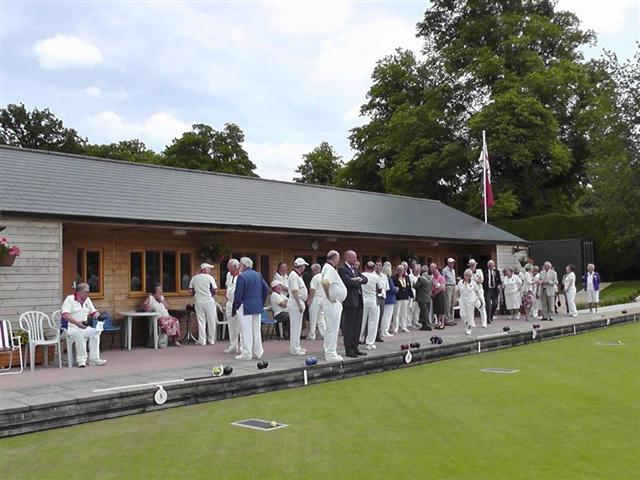
The ultimate accolade came, however, in the October of that year when Bowls England announced that the club had won the prestigious Bowls England/Drakes Pride National 'Club of the Year' Award.
Oakley contributes a great deal to the bowling community. During its short life, members have been President of the English Women's Bowling Association (EWBA), Bowls Hampshire, Hampshire County Women's Bowling Association (HCWBA), the North Hampshire Women's Bowling Association (NHWBA) (twice), the Basingstoke and District Bowling Association (BDBA) (4 times) and the Whitchurch League (twice).
Currently Oakley members hold the posts of Vice Chair, and Area Secretary (Ladies) of Bowls Hampshire and the Immediate Past President of the Basingstoke & District BA. Many of the Officer and Director posts in the local Indoor Club (Loddon Vale) have over the years been filled by Oakley members.
Despite its prowess in administration and bowling Oakley is as well known for its friendliness. It plays a large number of "friendly" games, both outdoors and indoors, has toured every year since 1982 in either England, Scotland or Wales and strives always to promote the game and to ensure fellowship in both bowling and social activities.